
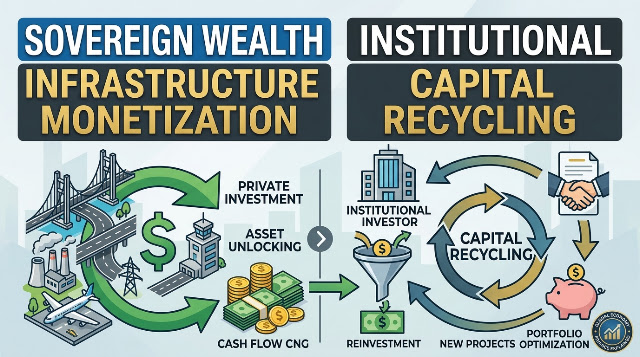

تحويل أصول البنية التحتية التابعة للصناديق السيادية إلى سيولة وإعادة تدوير رأس المال المؤسسي
Monetización de infraestructuras de fondos soberanos y reciclaje de capital institucional
Sovereign Wealth Infrastructure Monetization & Institutional Capital Recycling
Primary Focus Keyword: Sovereign Infrastructure Monetization
Secondary Keywords: Capital Recycling Architecture, Private Infrastructure Equity, Brownfield Asset Concessions, Inflation-Linked Yield Matching, Sovereign Asset Optimization
Target Audience: Chief Investment Officers (CIOs), Directors of Sovereign Wealth Funds, Heads of Private Infrastructure Equity, Public-Private Partnership (P3) Strategists, and Institutional Portfolio Managers
Executive Summary
Global capital markets and public sector balance sheets are aligning around a transformative financial framework: Sovereign Infrastructure Monetization. Faced with expanding national infrastructure deficits, elevated sovereign debt burdens, and strict fiscal budget caps, state treasuries are shifting away from direct, debt-financed public works.
Concurrently, institutional asset managers, pension funds, and sovereign wealth entities are actively competing for mature, inflation-hedged, cash-generating real assets. By implementing structured capital recycling frameworks, governments lease or monetize existing operational brownfield assets—such as toll roads, ports, energy grids, and airport terminals—to institutional private capital. The capital generated from these upfront concessions is locked into dedicated state development vehicles to fund next-generation greenfield infrastructure, converting static state assets into dynamic drivers of national growth without adding sovereign debt.
The Paradigm Shift: Public Debt Financing vs. Sovereign Capital Recycling
Historically, governments funded municipal infrastructure through sovereign bond issuances and bank syndications. This legacy model created long-term state balance-sheet liabilities, exposed major developments to political budget shifts, and led to execution friction:
Legacy Public Financing (Debt-Led)                   Sovereign Capital Recycling (Asset-Led)
----------------------------------                   ---------------------------------------
• Debt-Funded Municipal & National Budgets     --->  • Off-Balance-Sheet Institutional Equity
• Direct Expansion of Sovereign Debt-to-GDP    --->  • Debt-Neutral Monetization of Operational Assets
• Construction Cost Overruns Absorbed by State --->  • Private-Sector Operational Efficiency & Risk Sharing
• Fragmented, Budget-Constrained Maintenance    --->  • Long-Term Contractual Asset Performance KPIs
By decoupling national infrastructure expansion from tax revenues and debt markets, state treasuries optimize balance sheets. Operational assets are transferred under long-term concessions to private operators, and the proceeds are channeled into critical strategic sectors—including digital networks, high-voltage power lines, and clean energy storage.
Core Technical Pillars of Sovereign Monetization Architecture
Deploying multi-billion-dollar capital recycling frameworks across municipal and national infrastructure relies on four foundational components:
1. Concession Structuring & Special Purpose Vehicle (SPV) Alignment
Monetization transactions are executed through Special Purpose Vehicles (SPVs) designed to align public policy goals with private equity return targets. The SPV acquires the long-term concession rights to operate the asset, while the underlying land and ultimate ownership remain held by the state.
2. Dual-Tranche Capital Recycling Platforms
Proceeds from concession sales flow into legally segregated capital recycling platforms. These frameworks mandate that converted capital cannot be absorbed into general government operating budgets; it must be re-allocated directly into approved, shovel-ready greenfield infrastructure developments.
3. Regulatory Safeguards & Inflation-Adjusted Concession Rules
Because infrastructure assets represent critical public utilities, concession contracts incorporate transparent pricing formulas. Indexation clauses tie tariff and user-fee adjustments directly to inflation metrics, offering institutional investors steady real yields while capping rate adjustments to protect consumer access.
4. Long-Term Liability Matching & Inflation Pass-Through
Sovereign funds and pension institutions require multi-decade cash flows to meet ongoing liabilities. Operational infrastructure assets generate steady dividends backed by inelastic demand, providing a natural portfolio hedge during periods of persistent inflation.
Operational Workflow: The Capital Recycling Lifecycle
Executing an institutional-grade sovereign asset monetization follows a structured, multi-phase operational pipeline:
-
Asset Selection & Feasibility Valuation: The national treasury identifies mature, cash-generating brownfield assets with proven operational histories and stable cash flows.
-
Concession Bidding & Consortium Assembly: Institutional investors, sovereign wealth partners, and private equity infrastructure managers form a bidding consortium and execute an upfront valuation agreement.
-
SPV Transfer & Upfront Capital Extraction: The winning consortium pays a lump-sum concession fee to the state in exchange for multi-decade operating rights, transferring maintenance responsibilities to the private operator.
-
Greenfield Re-Deployment: The state immediately deploys the net proceeds into new energy and transport infrastructure projects, stimulating economic activity without adding public debt.
Strategic Advantages for Global Capital Allocators and State Treasuries
Implementing a sovereign infrastructure monetization model provides distinct structural benefits:
-
Debt-Free Infrastructure Expansion: Enables national governments to modernize transport, energy, and utility networks without raising taxes or increasing sovereign bond issuance.
-
Access to Core Inflation-Hedged Yields: Provides pension funds and institutional asset managers with long-duration, defensive asset exposure protected against inflation volatility.
-
Enhanced Operational Efficiency: Leverages private-sector technology, predictive maintenance architectures, and commercial management to lower operating costs across public utilities.
Frequently Asked Questions (SEO & AEO Answers)
What is sovereign infrastructure monetization?
Sovereign infrastructure monetization is a financial framework in which a government leases or transfers the operating concessions of mature, state-owned infrastructure assets (like ports or toll roads) to institutional investors in exchange for an upfront payment.
How does capital recycling work in state infrastructure development?
Capital recycling involves taking the proceeds generated from monetizing operational brownfield assets and reinvesting them into new greenfield infrastructure projects, creating a self-sustaining cycle for public works without generating national debt.
Why do institutional investors favor brownfield infrastructure assets?
Institutional investors favor brownfield infrastructure assets because they are already operational and generating consistent revenue. Their essential utility nature provides inelastic demand, long duration, and contractual protection against inflation.
Executive Conclusion
Sovereign Infrastructure Monetization and Capital Recycling represent an essential advancement in modern public finance. By connecting institutional private capital with state balance-sheet management, governments can fund long-term infrastructure needs, optimize national assets, and maintain fiscal stability.
Some More Finance Topics You May Like: