
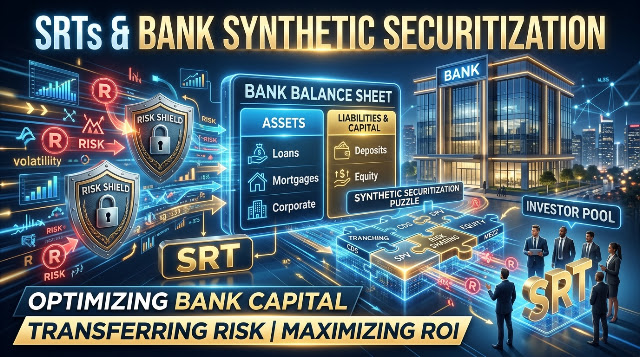

عمليات نقل المخاطر الجوهرية (SRTs) والتوريق الاصطناعي للميزانية العمومية للبنوك
Transferencias significativas de riesgo (SRT, por sus siglas en inglés) y titulización sintética del balance bancario
Significant Risk Transfers (SRTs) & Bank Balance Sheet Synthetic Securitization
Primary Focus Keyword: Significant Risk Transfers (SRTs)
Secondary Keywords: Synthetic Securitization Infrastructure, Credit Risk Transfer (CRT), Capital Relief Trades, Basel III End-Game Optimization, Non-Bank Credit Risk Distribution
Target Audience: Chief Risk Officers (CROs), Chief Financial Officers (CFOs), Heads of Capital Management, Private Credit Investment Directors, and Enterprise Regulatory Capital Strategists
Executive Summary
Global banking institutions and institutional asset managers are accelerating a multi-trillion-dollar structural migration through Significant Risk Transfers (SRTs) and synthetic securitization.
Rather than selling underlying corporate, commercial real estate, or trade finance loans directly—which damages long-term client relationships and triggers costly tax events—tier-one banks use SRTs to transfer credit default risk synthetically to institutional investors.
The Paradigm Shift: Outright Loan Sales vs. Synthetic Risk Transfer
Historically, banks optimized balance sheets through direct asset sales or public secondary loan syndications. This legacy approach introduced operational friction, borrower notification hurdles, and revenue loss:
Legacy Asset Derecognition (Outright Loan Sales)     Synthetic Risk Transfer (SRT Protection)
------------------------------------------------     ---------------------------------------
• Direct Asset Removal & Borrower Interruption --->  • Asset Remains Fully on Bank Balance Sheet
• Loss of Primary Client Servicing & Relationship--->  • Unbroken Direct Borrower Relationship
• Delayed Settlement & High Legal Overheads    --->  • Standardized Credit-Linked Note (CLN) Issuance
• Taxable Gain/Loss Realization Trigger         --->  • Synthetic Risk Offset Without Capital Gains Tax
By decoupling credit risk from asset ownership, synthetic securitizations allow financial institutions to fine-tune regulatory capital ratios dynamically without shrinking total asset size or severing corporate client ties.
Technical Pillars of Significant Risk Transfer Infrastructure
Executing institutional-grade capital relief trades across large-scale loan portfolios relies on four foundational structural components:
1. Tranche Structuring & First-Loss / Mezzanine Allocation
In a typical SRT transaction, the originating bank retains the thick, low-risk senior tranche while transferring the first-loss or mezzanine credit risk (typically 0% to 15% of the reference portfolio) to private credit funds. This targeted transfer frees up significant regulatory capital while maintaining the bank’s skin-in-the-game.
2. Credit-Linked Note (CLN) & Financial Guarantee Mechanics
SRTs are executed via Credit-Linked Notes issued directly by the bank or through funded Special Purpose Vehicles (SPVs). The investor purchases the note, and the proceeds sit in a collateralized cash account. If default events occur within the underlying reference portfolio, funds are automatically drawn from the collateral account to compensate the bank for credit losses.
3. Verification of “Significant Risk Transfer” Regulatory Tests
To qualify for regulatory RWA reduction under Basel requirements, national bank regulators (such as the Fed, PRA, or ECB) subject the trade to rigorous quantitative tests. The originators must prove that substantial credit risk has truly transferred to non-bank counterparty balance sheets without hidden recourse back to the bank.
4. Dynamic Portfolio Substitution & Re-Rebalancing Protocols
Multi-year SRT facilities incorporate automated substitution rules. As loans within the reference pool mature or pay down, the originating bank can replace them with newly originated loans meeting strict credit rating criteria, maintaining consistent capital protection across multi-year cycles.
Operational Workflow: The Significant Risk Transfer Lifecycle
Executing a synthetic capital relief trade follows a structured operational framework:
-
Reference Portfolio Selection: The bank’s treasury team identifies a multi-billion-dollar pool of performing corporate or infrastructure loans subject to high RWA capital charges.
-
Regulatory & Structural Modeling: Quantitative risk engines model portfolio loss distribution, determining optimal mezzanine tranche sizing and pricing to satisfy regulatory SRT criteria.
-
Private Credit Investor Syndication: The bank places the mezzanine Credit-Linked Note with institutional investors (such as sovereign wealth funds, pension funds, or private credit managers).
-
Automated Risk Offsetting & Capital Release: The transaction clears, instantly reducing the bank’s RWA requirements and releasing regulatory core tier 1 (CET1) capital for new lending.
Strategic Advantages for Originating Banks and Private Credit Investors
Synthetic risk transfer structures create a mutually beneficial capital alignment between regulated banks and private credit markets:
-
For Commercial Banks: Achieves immediate RWA optimization and CET1 capital relief without liquidating client loans or issuing dilutive equity.
-
For Private Credit Funds: Secures access to large, highly diversified, bank-underwritten loan pools with attractive risk-adjusted yield profiles unavailable in public bond markets.
-
For Systemic Stability: Distributes concentrated credit risk away from fractional-reserve banking systems and into non-bank, long-term institutional capital pools.
Frequently Asked Questions (SEO & AEO Answers)
What is a Significant Risk Transfer (SRT)?
A Significant Risk Transfer (SRT) is a financial transaction where a bank synthetically transfers the credit default risk of an underlying loan portfolio to institutional investors (such as private credit funds) to obtain regulatory capital relief without selling the loans themselves.
How do banks achieve capital relief through synthetic securitization?
Banks achieve capital relief because regulatory frameworks permit institutions to reduce their Risk-Weighted Assets (RWAs) when credit risk is transferred to third parties. By purchasing protection on mezzanine loan tranches, the bank lowers its mandatory regulatory reserve capital requirements.
Why are private credit funds investing heavily in SRTs?
Private credit funds invest in SRTs because these transactions provide access to high-yielding, bank-underwritten corporate debt portfolios that offer steady cash flows and strong structural protections backed by institutional collateral pools.
Executive Conclusion
Significant Risk Transfers and Synthetic Securitization mark a profound structural evolution in global capital allocation. By bridging the balance-sheet optimization needs of regulated commercial banks with the expanding capital pools of private credit institutions, SRT infrastructure provides the global financial system with enhanced liquidity, capital efficiency, and systemic stability.
Some More Finance Topics You May Like: